Legendary programmers who contributed hugely to and had a lasting influence on the software development profession, as well as an extraordinary personal background:
Ada Lovelace, for the first algorithm on a Turing machine (Bernoulli numbers), which included conditional branches, loops and subroutines, and for recognizing such a machine is capable of more than solving numerical problems.
Donald Knuth, for a work of beauty on TAOCP and TeX.
Dennis Ritchie and Ken Thompson, for Unix and C, laying the groundwork for today's server operating systems.
Bill Gates, for his contribution to the microcomputer software revolution, combining technical brilliance (Altair Basic) with business instinct (dealing with IBM) at a very young age.
John Carmack, for revolutionizing game programming several times.
Linus Torvalds, for bestowing Linux and git upon the world.
There were other auctions on rare products, e.g. an Apple Lisa (went away for USD 700) and a NeXTStation (sold for USD 200 - man, I should have bought it!).
I am kind of running out of table space in my cellar, that's why I cannot provide any actual images yet of the entire collection, so for the meantime there is this photo of a previous state.
The DOS 2.10 disks - which by the way I purchased in Australia - arrived today, so I tried to convince my IBM 5150 to boot. Unfortunately it did not recognize the disk at first, and continued to jump to the built-in Basic interpreter. I had no possibility to check the disk on any other system. What to do next? I mean this thing doesn't even have a BIOS, it has... DIP switches on the motherboard! I should note that my IBM did not come with the two standard 5.25" floppy drives, but one floppy drive and one 10MB hard drive, so I figured there might be some misconfiguration. Luckily I still found documentation on the 5150 DIP switch settings, and after flipping one switch I was able to boot.
Current date is Tue 1-01-1980 Enter new date:Current time is 0:00:12.89 Enter new time:The IBM Personal Computer DOS Version 2.10 (C)Copyright IBM Corp 1981, 1982, 1983
A> _
Next steps: Backup the only DOS 2.10 disk I have, and try to install DOS on the hard disk. Hard disks were supported from DOS 2.0 on - so this should work as well. Oh yeah, DOS 2.0 also introduced subdirectories...
After weeks of trying I finally managed to buy an IBM 5150 on EBay (yes, that's the first IBM PC). EUR 100 plus EUR 70 for shipping - but hey, it's worth the price.
I found original IBM DOS 2.0 disks as well, which complete the whole purchase (IBM DOS 1.1 or 1.0 would have been even better, but they are also more rare).
BTW, I highly recommend the movie "Pirates Of Silicon Valley", which - as far as I can tell - provides a quite accurate picture of the PC revolution, plus it's very entertaining. Years ago I bought both the english and the german movie version, still back on VHS. I must have watched it a dozen times since then.
A colleague of mine - knowing about my interest for ancient computers - recently asked me whether I knew which system they were using in the 1968 movie "Hot Millions" with Peter Ustinov. I remember having seen this picture once, and I also remember they had a mainframe in the scenery. But the only image I could look up in internet is this one with Ustinov sitting in front of a terminal. I guess I will have to watch "Hot Millions" again in order to find out.
Anyway, this question caught my attention, so I did some more research and discovered that the first appearance of a computer in a cinema movie was probably a mockup named "EMERAC" (reminiscenting about ENIAC or UNIVAC?) in "Desk Set" with Katherine Hepburn from 1957. It even consisted of real computer parts, namely IBM 704 magnetic tapes and some panels from the famous SAGE military computer (based on vacuum tubes and ferrite core memory).
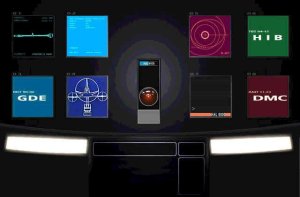
No list of computers in old movies would not be complete without HAL9000 from "A Space Odyssey". Timeless.
Nice article about 30 Years Of Personal Computer, just one doubt: Did the Tandy-Radio Shack 80 really outsell the Apple II in the late 70s? I always assumed Apple was market leader until the introduction of the IBM PC.
By the way, we both had a TRS-80 and some Commodore CBMs side by side at school but we only used the Commodore, because to us it somehow seemed cooler.
The History Of Computing Project provides plenty of information on companies and individuals who helped to shape today's computer industry. It includes historical anecdotes and timelines, e.g. a summary of Microsoft's history. What's missing in the 1980/1981 entries (dawn of the IBM PC and DOS) is the story how Bill Gates outmaneuvered Digital Research and Gary Kildall, then leading 8-bit OS vendor with their CP/M system. So here is a summary of what happened. I must have heard / read dozens of slightly different variations on this story over the years, so this outline of events should be pretty accurate:
Bill Gates
Gary Kildall
Back at that time, Microsoft provided programming languages (Basic, Fortran, Cobol and the like) for 8-bit machines, while the most-widespread operating system CP/M came from Digital Research. The two companies had an unspoken agreement on not raiding the other one's market. But Microsoft had licensed CP/M for a very successful hardware product at that time - the so called SoftCard for the Apple II. SoftCard contained a Zilog Z80 processor, and allowed Apple II owners to run CP/M and CP/M applications.
IBM - awakened by Apple's microcomputer success with the Apple II - approached Microsoft in search of an operating system and programming languages for their "Project Chess" = "Acorn" = "IBM PC" machine, which was to be a microcomputer based on open standards and off-the-self parts. Those off-the-self parts included Intel's 8088 CPU, a downsized 8086. One exception was the BIOS chip, which was reverse-engineered later by Compaq and others.
The legend goes that IBM's decision makers mistakenly thought CP/M originated from Microsoft, but that sounds doubtful. Anyway, Bill Gates told IBM they would have to talk to Digital Research, and even organized an appointment with Digital Research CEO Gary Kildall.
Kildall was a brilliant computer scientist, but probably missing the business instinct and restless ambition of Bill Gates. Some people say Gates didn't inform Kildall about who the prospective customer was, but only noted that "those guys are important", which might be plausible, as IBM was paranoid about anyone getting to know what they were doing. On the other hand, Gates himself once mentioned in an interview that Kildall knew it was IBM who was coming.
Digital Research's former headquarters, Pacific Grove, California
So the next day some IBM representatives, including IBM veteran Jack Sams, flew from Microsoft's office in Seattle to Pacific Grove, California, where Digital Research was located. When they arrived, Kildall was not there. While Gates later commented that "Gary went flying" (Kildall was a hobbyist pilot), truth is that Kildall had already another meeting scheduled and was visiting important customers, and flew his own plane to get there. Kildall's wife Dorothy McEwen and her lawyer fatally misjudged the situation in the meantime and declined to sign IBM's nondisclosure-agreement, so IBM left with empty hands. It should be noted that Gates had no problem signing a NDA.
Again, different versions exist about that part of the story - one of them goes that Kildall actually appeared in the afternoon, but no agreement was reached either. Another problem at that time was that Digital Research had not even finished CP/M's 16bit 8086-version.
When IBM returned to Microsoft still looking for an operating system, Gates would not neglect that opportunity. Microsoft co-founder Paul Allen knew of a 16-bit CP/M clone named "Quick and Dirty Operating System" (QDOS), written by Tim Paterson of nearby "Seattle Computer Products". Paterson had grown tired of waiting for CP/M-8086, so he had decided to build one on his own. In a matchless deal, Microsoft purchased QDOS for a mere USD 50,000, and transformed it into PC DOS 1.0. IBM had unexclusively licensed DOS, which opened doors for Microsoft to sell MS DOS (back then slightly varying versions) to every PC clonemaker that would come along.
At the same time, Digital Research finally finished their 16-bit CP/M, which was even offered by IBM as an alternative to DOS, but never took off mainly because of pricing reasons (USD 240 for CP/M in comparison to USD 40 for DOS). Thanks to the similarities between DOS and CP/M, CP/M applications were easily ported to DOS as well - sometimes it was enough to change a single byte value in the program's header section.
Back then IBM still believed that even on the microcomputer market, profits would stem from hardware sales, not from software sales (remember they gave operating system and standard applications away for free in order to sell mainframes - software was a by-product). Their next mistake was to open doors to clonemakers thanks to their open-standards approach and their licensing agreement with Microsoft. IBM also paid a high price later during their OS/2 cooperation with then-strengthened Microsoft, when Microsoft suddenly dropped OS/2 in favor of Windows.
Myths entwine around the real events, and a lot of wrong or over-simplified versions are circulating. People tend to forget that Microsoft was quite successful long before the days of DOS, selling their Basic version, which ran on more or less every 8-bit microcomputer. They actually began in 1975 on the famous Altair. And no, Gates and Allen did not start their company in a garage (those were Steve Jobs and Steve Wozniak with Apple), they established Microsoft in Albuquerque, New Mexico - because that was where Altair producer MITS had its headquarters. Some years later they moved back to their hometown Seattle.
One of my college teachers once told us that "IBM came to Seattle to talk to an OS vendor, but those guys were out of town, so they went to Microsoft instead". Isn't the real story so much more amazing than that oversimplified one?
Update 2016: I found this Tom Rolander interview, who actually "went flying with Gary" that fateful day (at 17min 7sec):
In 2015 I held this presentation on the "History of the PC" at Techplauscherl in Linz:
Yes, that's the one where MITS announced the Altair 8800, the one issue that Paul Allen happened to notice at a local newsstand on Harvard Square, Cambridge (Allen was working for Honeywell in nearby Boston at that time). He bought it and showed to Bill Gates at his friend's dorm room. "It [the PC revolution] is going to happen", Gates knew. Here was their opportunity to do something with Basic...
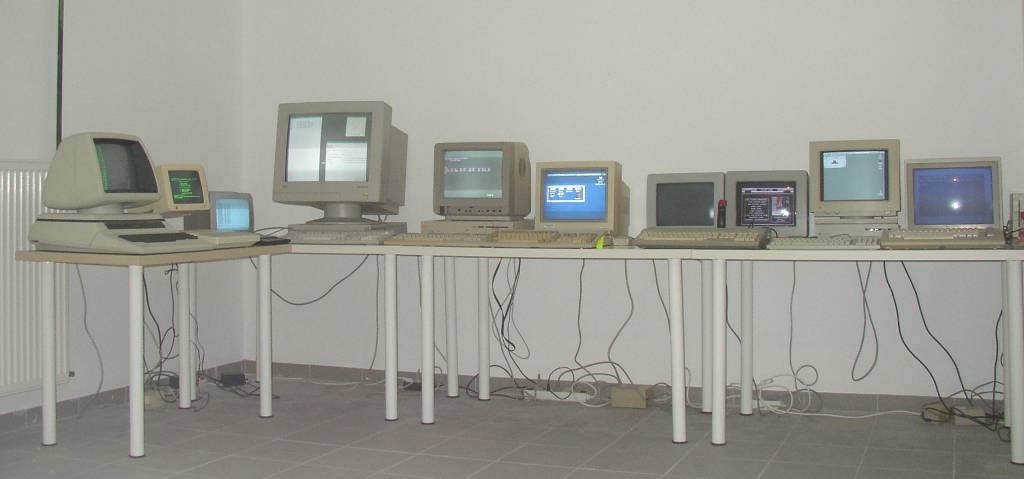
From left to right: (1) Commodore CBM8032 (2) Apple IIc, Apple II Green Composite Monitor (3) Sinclair ZX81, B+W TV Set (4) Sun SparcStation 5, NEC 21" VGA Monitor (5) Commodore 128D, Commodore 1901 Color Monitor (6) Commodore Amiga 500, Commodore 1085S Color Monitor (7) Atari 1040ST, Atari SM124 Monochrome Monitor, Atari SC1224 Color Monitor (8) Apple Macintosh LC, Apple Monochrome Monitor (9) Commodore 64, Commodore 1541 Floppy Drive, Commodore 1081 Color Monitor
Latest Purchases: (1) Apple IIc, Apple II Green Composite Monitor (2) B+W TV Set for Sinclair ZX81
Currently looking for: (1) Tape Recorder for Sinclair ZX81
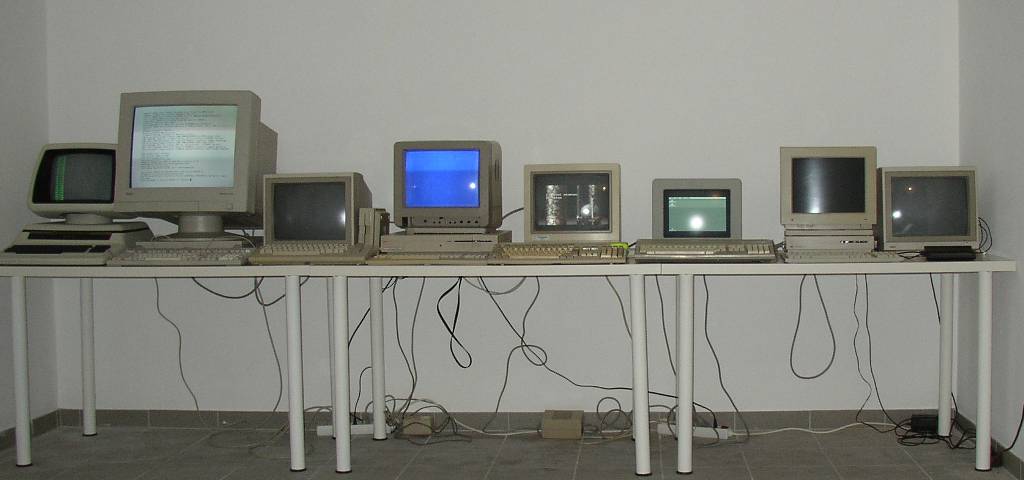
From left to right: (1) Commodore CBM8032 (2) Sun SparcStation 5, NEC 21" VGA Monitor (3) Commodore 64, Commodore 1541 Floppy Drive, Commodore 1081 Color Monitor (4) Commodore 128D, Commodore 1901 Color Monitor (5) Commodore Amiga 500, Commodore 1085S Color Monitor (6) Atari 1040ST, Atari SM124 Monochrome Monitor (7) Apple Macintosh LC, Apple Monochrome Monitor (8) Sinclair ZX81, Commodore 1084 Color Monitor
Latest Purchases: (1) Atari SC1224 Color Monitor
Currently looking for: (1) Apple II (2) TV set for connecting the Sinclair ZX81 (3) Some more power cables
The Mac LC is booting, but is missing its mouse right now (luckily the original contributor found it in the meantime). And I am still looking for a small TV set for the Sinclair ZX81 (the ZX81 has a built-in TV modulator, and a TV-out connector only - though it is possible to grab the original video signal directly from the board, this seems too risky for me as I am not a hardware expert at all, and I am afraid to blow up the board when trying).
My Sun SparcStation is currently running OpenBSD, but I consider switching over to Solaris.
Did I mention that I was out-bid ONCE AGAIN on eBay for an Apple IIc? What's wrong? Everyone seems to go crazy for the Apple II right now.
"I used to be a contractor for Apple, working on a secret project. Unfortunately, the computer we were building never saw the light of day. The project was so plagued by politics and ego that when the engineers requested technical oversight, our manager hired a psychologist instead. In August 1993, the project was canceled. A year of my work evaporated, my contract ended, and I was unemployed.
I was frustrated by all the wasted effort, so I decided to uncancel my small part of the project. I had been paid to do a job, and I wanted to finish it. My electronic badge still opened Apple's doors, so I just kept showing up."
Since I finally got sufficient space in my new cellar, I started looking for old computer systems - mainly 8bit and 16bit home computers I owned in the past, or others that I would have liked to possess back then. The problem always used to be: in order to buy the next generation computer, I had to sell my old one - pocketing horrible losses most of the time.
Today my major source is EBay. Still it's an elaborate task to find and purchase the right hardware, external devices and cabling. And: some prices just go through the roof at EBay. E.g. I must have bid on an Apple II on at least five occasions, but so far it always turned out too expensive at the end.
So here is my current collection:
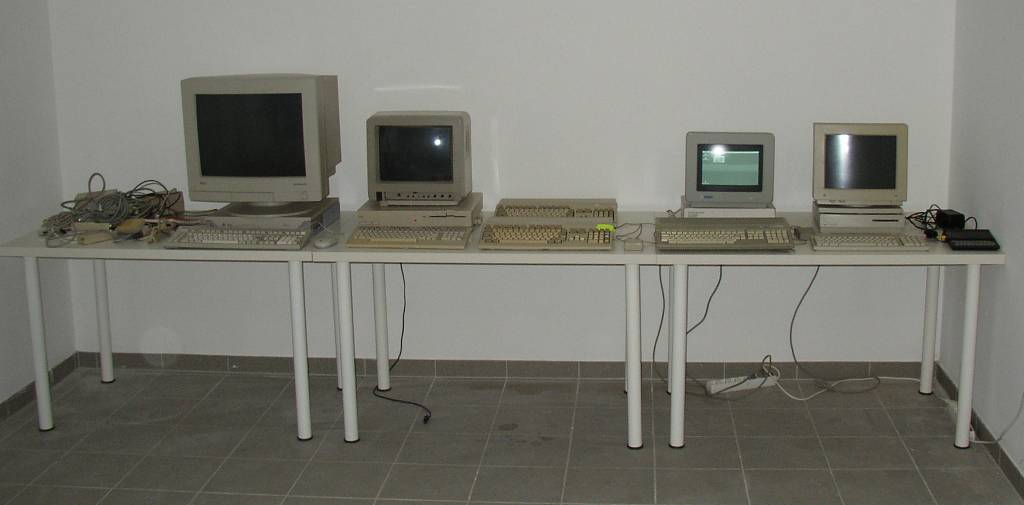
From left to right: (1) Sun SparcStation 5, NEC 21" VGA Monitor (2) Commodore 128D, Commodore 1901 Color Monitor (3) Commodore Amiga 500 (2x) (4) Atari 1040ST, Atari SM124 Monochrome Monitor (5) Apple Macintosh LC, Apple Monochrome Monitor (6) Sinclair ZX81
Latest Purchases: (1) Commodore CBM8032 (2) Commodore 1084 Color Monitor
Currently looking for: (1) Apple II (2) Atari SC1224 Color Monitor
What might be less known is that the initial project goals were quite different from what turned out to be Windows NT 3.1 about five years later. NT was aimed to be the successor of OS/2, Microsoft's and IBM's joint operating system. One of the first requirements was OS/2 compatibility. As a matter of fact, NT was originally called "OS/2 3.0", and later on "NT OS/2". Working on the OS/2 flavor of NT also caused some tension between the former DEC engineers who had come with Cutler over to Microsoft, and Microsoft's OS/2 developers. Anyway, OS/2 compatibility was dropped when Microsoft chose to back out of OS/2 in favor of Windows.
Another surprising fact is that DEC became increasingly interested on the NT port for their new Alpha processor when then-under-development NT gained momentum in the beginning of the 90's. What a late victory that must have been for Cutler, whose efforts on building DEC's new operating system "Mica" for their then brand-new RISC-platform Prism were futile, when DEC cancelled the project in 1988, which lead to Cutler's departure.